
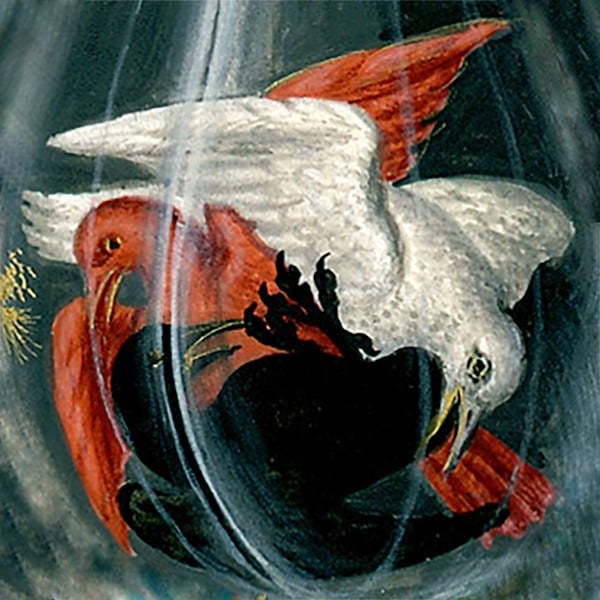
The ancient alchemists’ quest to transform base metals such as lead into gold unfolded in generally agreed-upon color-stages, from black (the nigredo), to white (the albedo) to red (the rubedo). Today we understand these color stages, as described by C.G. Jung and others, as the process of transformation in the human psyche—empirically validated in a doctoral thesis by the sequence of colors emerging in Dr. Ehlers’ dreams over a 15-year period (Ehlers,1992).
The first half of the program will be devoted to an exploration of the psychological meaning of the color-stages, illustrated with images from art. We then move in depth to the significance of the albedo and the rubedo as a complementary pair in the psyche, representing archetypal feminine and masculine energies. Corroboration for these opposites as a pair is found not only in cross-cultural color symbol-systems worldwide and across time but also in contemporary studies of the neuroanatomy of the human brain. We will discuss the challenges we and our clients face in balancing these two energies in our daily lives.
In the second half of the program, we will focus on these colors in the sandplay of a deeply wounded woman on her transformational 22-year journey from addiction and the self-destructive behavior of her past to a radiant new life.
Suggested Reading
Learning Objectives
This course is intended to help you:
Presenters
 Lynne L. Ehlers, PhD, is a licensed clinical psychologist and teaching member (CST-T) of Sandplay Therapists of America (STA) and the International Society for Sandplay Therapy (ISST). She has worked with her dreams since childhood and began a ten-year personal sandplay process in 1977. She has served on the faculty of the Dream Studies Program, as adjunct faculty in the Sandplay Studies Program at John F. Kennedy University and as guest lecturer, visiting scholar, and associate professor at Sonoma State University. She has presented papers at dream conferences sponsored by the International Association for the Study of Dreams (IASD), and biennially at both national and international sandplay conferences since 2009. She is the author of Alchemy and Individuation: The Colors of Transformation, Analytical Psychology Press, 2022. Her many articles have appeared in the Journal of Sandplay Therapy, and “The Tao of Sandplay Therapy” appears as a chapter in Into the Heart of Sandplay, edited by Dyane N. Sherwood and Betty C. Jackson (Sandplay Editions 2018). Dr. Ehlers offers sandplay, dreamwork, case consultation, and Jungian-oriented depth psychotherapy to adults in Albany, California.
 Dyane N. Sherwood, PhD, did her own sandplay process in the mid-1980s and has been using sandplay with adults and children for nearly 40 years. She offers sandplay process in her office in Evanston, Illinois, and she teaches and consults internationally. She is an Analyst Member, Teaching Faculty, and immediate Past President of the C.G. Jung Institute of Chicago. Dr. Sherwood is certified as both an Adult and Child Jungian Analyst by the International Association of Analytical Psychology and is a Teaching Member of the Sandplay Therapists of America/International Society for Sandplay Therapy. Dr. Sherwood is the Editor and Publisher of Analytical Psychology Press (analyticalpsychologypress.com), which has published books on Sandplay, including a new edition (2020) of Dora Kalff’s foundational book, originally published in 1980. Her practice website, where you can find copies of her articles, is dyanensherwood.com.
References