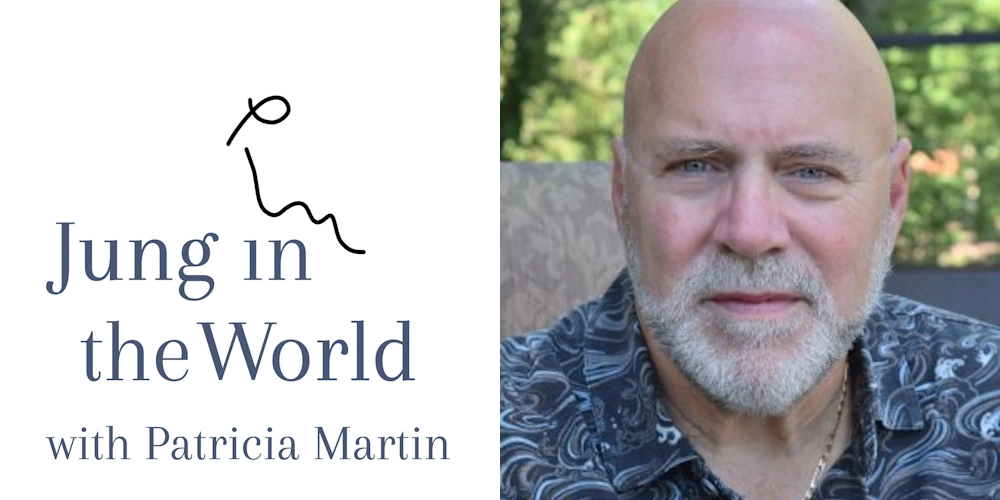
Carl Jung called it “an acausal connecting principle” — but for Dan Ross, a Jungian analyst working in hospice care, synchronicity isn’t just theoretical. In this episode, Dan reveals what thirty years of end-of-life work taught him about Jung’s most misappropriated theory, its roots in Jung’s relationship with physicist Wolfgang Pauli, and why studying synchronicity seems to produce more of it. This episode is rich with poignant examples blended that will leave you thinking differently about how synchronicity works in your own life.
In preparation for the upcoming Christopher Nolan film, we begin our coverage of The Odyssey with a focus on the isles of Polyphemus and Calypso. As the story is far too long to read aloud, Raisa reads a summary of Odysseus’s encounter with Polyphemus from Claudio Patrini’s, “Odyssey: Symbols and Meaning.”
How does conspiracism appear from a Jungian perspective?
Psychologically speaking, conspiracy theories are, in essence, theories about hidden connections between reality and fantasy. The desire to discover reality and explore the deeper meaning of existence is instinctive. Mythology and ritual behavior testify to humanity’s ancient effort to grasp the mystery of life and use that knowledge to navigate reality more effectively through the expansion of consciousness. Similarly, religion responds to the human longing for salvation and the revelation of eternal truth—a desire, one might say, to crack the ultimate code of existence. Conspiracy theories are driven by the same instinct.
From a Jungian perspective, conspiracy theories may be understood as private—or what I have elsewhere called dark religious—systems through which the ego attempts to come to terms with the overwhelming impact of numinosity. Numinous experience arises from an encounter with the paradox of the holy, what Rudolf Otto termed the mysterium tremendum et fascinans: an experience that simultaneously evokes fascination and awe. The less conscious the ego is of these opposing emotional forces, the more likely it is to become possessed by them. The key is to minimize the phenomenon of splitting so that the ego may proceed further in the quest for the integration of the Self.
Conspiracy theories may thus be regarded as partially protective and partially healing constructs through which a person is able to experience relief from existential anxiety while simultaneously achieving a provisional grasp of reality. They provide the conspiracist with a feeling of personal power and control over reality. By “revealing” evil and its causes, they alleviate so-called negative feelings and temporarily restore a sense of meaning, orientation, and certainty.
Judith Herman is widely known as a defining voice in trauma psychiatry for more than fifty years. Her work bridges the personal and the political, framing trauma as not only an individual experience, but a public health and human rights issue. In this interview with host Patricia Martin, Judith Herman tells the story of how her work evolved, what remains to be done for CPTSD victims, and what all of us can do to create conditions survivors need to heal.
The first of a grim pair of episodes depicting filicide within Greek myths. We piece together the story of Agamemnon’s sacrificing Iphigenia for favorable winds – and the fallout of such action after the war. All this with an eye for how the choices parents make either support or harm the parents’ individuation.
Psychotherapist Daniel Shaw survived a decade in a cult — then spent 30 years helping victims of traumatic narcissism heal. He talks with host Patricia Martin about the mechanics of subjugation, why “no contact” isn’t always the answer, and how reclaiming dignity supports recovery.
While our last episode discussed Orpheus through the lens of archetypal creativity, this episode focuses on the grief elements of the story as depicted in Ovid’s version of the story. We share our own grief stories and explore the hazards experienced when people do not allow themselves to grieve.
What if the harms of living an increasingly digital life go beyond undercutting our attention spans or blunting our social skills? What if it cuts deeper, to the core of who we are and who we know ourselves to be?
Patricia Martin, author, researcher, and host of the Jung in the World podcast, explores the challenges that tech and the internet impose on the human psyche. In Will the Future Like You? Reflections on the Age of Hyper-Reinvention, she argues that 24/7 online connectivity reshapes not only our sense of self, but erodes our very ability to form our identities.
Weaving together memoir, depth psychology, cultural criticism, and reportage, Martin guides readers through the hidden processes that form identity — and reveals how digital life is quietly dismantling them. At once a rigorous inquiry and a deeply human one, Will the Future Like You? asks what it means to hold onto a coherent self in an era designed to keep us endlessly reinventing. Releases March 5, 2026; Karnac Books UK. Available for pre-order on Amazon.
“Courageous, urgent, and deeply necessary.”
–James Hollis, Jungian analyst, author of Swamplands of the Soul and Living with Borrowed Dust, and 22 other books.
About the author:
Patricia Martin writes about the intersection of culture, psychology, and technology. A graduate of the JSP and a professional affiliate at the C. G. Jung Institute of Chicago, where she hosts the popular podcast Jung in the World. She spent the last decade researching digital culture’s impact on the psyche. The author of four books, her work has been featured in the New York Times, Harvard Business Review,Huffington Post and Psyche Magazine. Learn more: www.patricia-martin.com
Our Blog shares essays, articles, video, audio, and other resources by members of the Chicago Society of Jungian Analysts and other groups that support the education and development of our community.
The views and opinions expressed in the podcasts and blog posts are those of the respected speakers or authors and do not necessarily represent the views of the C. G. Jung Institute of Chicago.