
Psychologie.cz | The Fisher King Without Clothes: Interview with Vlado Solc
This article originally appeared on psychologie.cz. Vlado Solc, member of the Chicago Society of Jungian Analysts, is interviewed by Jan Majer, Editor-in-Chief of Psychologie.cz.
In his books, Jungian Analyst Vlado Solc has been describing for many years how high politics is increasingly dominated by base motives – envy, frustration, the need for revenge. The turn of events is unexpected and disturbing. And beneath the surface, something deeper is happening. It’s not about politics, it’s about the soul.
Jan Majer – Years ago, you pointed out that high politics and society were increasingly being driven by low motives — envy, frustration, the need for revenge. In recent weeks, a lot has happened. What new insights have these events brought you? What psychological connection have you realized?
~ Vlado Šolc – Even before Donald Trump entered the political scene, low impulses had begun to awaken in American society. I called it an emergence of the Narcissistic archetypal dynamics. This goes beyond individual vanity — Narcissus is a symbol of psychic fragmentation, of the ego being consumed by an image of oneself to the point that deeper, conscious connection becomes impossible. Psychologically, this represents a splitting of psychic opposites, a loss of living contact with the soul, which typically leads to a loss of compassion, perspective, and understanding of higher motives such as art, ethics, and spirituality.
In this fragmented state, what had previously been considered via lenses of moral anxiety suddenly became a new value, no longer viewed with fear, but with fearless excitement. Trump rose up as a great object of collective projection of this American complex; as a chosen Über-Narcissus, he legitimized these shadowy emotions — rage, entitlement, xenophobia — which had previously been suppressed due to social oversight. He thus gave permission for the collective shadow to manifest openly, without shame.
This opened the door to authoritarian dynamics and all narcissistic manipulation that catalyzes it. When society is psychologically fragmented, when people lose inner and outer cohesion, they often seek a dominant figure to restore a sense of order — someone emotionally expressive, certain, and seemingly strong. Manipulators and narcissists channel the chaos of the collective psyche and provide it with temporary relief by directing the collective shadow outward onto scapegoats: the state, immigrants, or anyone slightly different from oneself.
Many experiences of the hardships that come upon us in a rapidly changing world are like splinter-traumas that we are unable to process smoothly. They, for many, create fragility that weakens the strengths of ego-consciousness and causes societies to regress — emotionally, morally. Think of the unmet needs of the small child, unable to find expression in words, instead acted out in rage, projection, or magical thinking. Beneath the surface, there are legitimate needs of security, belonging, fairness, and transformation — but without mindful reflection, they emerge in distorted, primitive forms.
Moreover, trauma calls out protective archetypal fantasies that are beyond time. It manifests unconsciously as a longing for the past, a longing for a golden age. Thus, slogans like “Make America Great Again” reflect this nostalgia; it is a deep psychological defense against the painful present.
As a nation, speaking collectively, we are undergoing an alchemical nigredo — a dark, on the surface disorienting, phase of dissolution. What is dissolving are established concepts that the ego cling onto in order to handle reality, but everything changes, and nothing is permanent; our reality is at the same time a maya, illusion, supported by collective hypnosis. Without the real, conscious confrontation with the darkness, with all those outlived parts of our lives, without authentic suffering, transformation is not possible. In this stage, fixed structures need to collapse, and pieces be linked via pathways of new vital psychic energies. That always hurts; the suffering must be integrated, not bypassed through scapegoating, conspiracy fantasies, or new idealizations that only create new collective hypnosis. Otherwise, the unconscious contents will simply be projected onto new objects, new false ways of escaping reality will be created, repeating the same cycle.
In the projection, Trump initially emerges as a kind of savior — a screen through which disowned emotions can be manifested. But over time, he becomes a mirror. This is an archetypal pattern through which consciousness arises: the first phase is idealization, expectations are magically assigned to the Redeemer; the second phase is disillusionment, where the projection collapses and reality steps in and can be reflected upon. If the projections are withdrawn consciously, there is a chance for a new light. If not successful, it merely shifts to the next fantasy-image.
Looking deeper through a symbolic lens, Trump’s role embodies the Trickster that has many narcissistic qualities — a figure who disrupts, mocks, but also unwittingly reveals hidden hypocrisies without necessarily offering any viable solutions. The Trickster triggers activation of the shadow but also risks unleashing chaos if there is no good container to hold the confrontation consciously.
We could also see aspects of the Wounded King archetype: when his personal wounds mirror the land’s sickness. Ultimately, in alchemical view, the king must die within the crucible of nigredo. Trump will very unlikely personally transform, but through him, the collective shadow has been exposed. If society remains trapped in the us-versus-them paradigm — seeing him solely as a villain or savior — opposites will remain separated and in a clashing state. But if we polish the mirror, if we see clearly the face of what has been disowned within ourselves, then the work of soul can begin.
This is why I believe that even though there is great danger in current societal development, there is also profound opportunity for transformation. Trump as a cultural phenomenon reveals the psychic map with many swampy areas that we are collectively inhabiting. Healing requires that we do not merely fight external battles but engage in slow, rather difficult inner work — the vulnerable work of mourning illusions, enduring disillusionment, and accepting responsibility for the planet we inhabit, including all living creatures.
Ultimately, most likely, the Trump presidency will uncover the ancient truth that what is asked of us is not to find another “redeemer,” but to redeem ourselves.
Jan Majer – You mention the alchemical phase nigredo — a period of darkness that can precede inner transformation. What might follow? Is there a chance that, as a society, we will also go through a phase of rebirth, like in the legend of the Fisher King? And could the same people who today admire the “Über-Narcissist” one day prefer a figure who embodies more mature emotions and values? Or is it just as likely that things will get even worse in the future? Can psychology offer us any insight into this?
~ Vlado Šolc – Narcissistic splitting is essentially a regression into a more primitive psychic state in which the ego is still merged with the Self and thus feels omnipotent and superior. However, this feeling is illusory because it is disconnected from reality. It represents profound disharmony of being in the world, disharmony with the principles of existence. Such a state is not sustainable over time — it goes against the instinctual direction of psychic development, which, as Jung teaches, seeks expansion: not expansion of ego, but expansion of the Self, the conscious union with reality in all its painful and magnificent complexity.
Naturally, no one can predict how deep the rupture must become before society begins to feel the inevitable consequences of its own “darkness.” It would not be the first time in history. In therapy, we often observe a similar process: a person’s illusory stance becomes so out of sync with their environment that “something happens” — a crisis, a confrontation, or even a collapse. DUI, bankruptcy, heart attack, or divorce… The family may no longer be willing to tolerate denial, manipulation, or pretense. The narcissistic bubble of perfection bursts. And then, for the first time, real problems must be addressed with humility and truthfulness.
Thomas Aquinas, in his mystical work Aurora Consurgens (Rising Dawn), describes the soul as a wounded bride longing for union with her bridegroom. The soul yearns for union with matter, for embodiment, for realization. But there is a descent into chaos and pain before such a union can take place — a bleeding wound precedes the healing, the birth of consciousness. For the awakening, “the body has to be spiritualized, and the spirit has to be incarnated; both things must take place,” says Jung.
Similarly, in the legend of the Fisher King I mentioned, the king suffers from a mysterious wound in the groin that renders him impotent and immobile. His land turns into a barren wasteland. He can do nothing but sit by the river and wait — wait not for conquest or command, but for a fish. Knights are sent in search of the Holy Grail that could heal the king and the land. Yet it is only Parsifal, the naïve fellow with a pure heart, who, after years of wandering and stumbling, matures enough to ask the simple but essential question: “What ails you, my king?”
It is this act of sincere inquiry — of daring to approach suffering without judgment or denial — that breaks the curse. The king is healed. The land is fertile once again.
In this myth, Parsifal acts like a therapist: he dares to look inside the wound, to ask about it rather than blame others or seek false remedies. He nudges the king to enter into a relationship with suffering.
Many people on a personal level will not be able to ask this question, but society as such can build institutions that serve as pillars of conscious structures.
Whether rebirth follows nigredo depends on our willingness, individual and collective, to endure the suffering, to ask the mindful questions, and to relinquish false certainties. As Jung famously exclaimed: “There is no coming to consciousness without pain.”
Only through honest insight into our wounded land can we move toward a more conscious and compassionate society.
Jan Majer – It seems that the rise of selfish politics — politics that is ruthless, exploitative, manipulative, and deceitful — is not merely an American phenomenon. Let us look at history and ponder what led to the collapse of empires or world conflicts. The narcissistic paradigm often emerges from a disrupted harmony — such as the consequences of economic decline, social inequality, the destabilization of economic systems, or the weakening of national and cultural confidence. A narcissistic leader, typically an advocate of “low motives” such as fear, resentment, scapegoating, and the desire for dominance or purity, offers simple solutions — ones the masses can grasp and emotionally resonate with. Why do you think this is happening now?
~ Vlado Šolc – When people feel un-whole, lost in their place, powerless or humiliated — economically, socially, or culturally — they unconsciously seek a figure who appears strong, confident, and unbothered by self-doubt. The narcissistic leader mirrors back a wishful, idealized fantasy image that appears powerful, entitled, victorious on the surface. In this sense, the leader serves as a container for collective hope and collective shadow alike — embodying not only people’s aspirations but also their disowned aggression, prejudices, and need for power and control. The leader feeds a delusion that the shadow’s way is a noble one!
If we ask “why” this phenomenon arose now, three different perspectives come to mind.
First, there is why as a cause (causa efficiens) — the source. Here we can name several major societal factors: global climate change destabilizing established ways of life; the rapid pace of social transformation catalyzed by social media; and, more recently, the unexpected influence of artificial intelligence, among others. All these forces intensify uncertainty, anxiety, and a sense of loss of control.
Second is why as a reason, motive, or image (causa praesens) — what feeds the phenomenon in the present moment hic et nunc. In my practice, I often observe how many clients experience anxiety, depression, or rapid mood changes without insight, relation, or attempt to understand. When emotions are dissociated from ego-consciousness, they manifest rather in a raw, “shadowy” form — as fear, anger, or shame — and are easily projected outward in an attempt to find a villain that is responsible for them. This projection fuels social conflicts, conspiratorial thinking, and scapegoating, creating a climate of paranoia, flight-or-fight responses.
And finally, third why is why as an intent (causa finalis) — the purpose. The psyche possesses a self-healing drive, aiming to unite opposites and harmony. Jung teaches that when opposites break apart, the unconscious creates compensating energy and manifests through enactments that in turn demand engagement, response. Crises, we can say, are summons to individuation.
That alchemical nigredo — the experience of chaos and darkness — coincides, in fact, with the noble truth expounded by the Buddha: there is suffering. There is no bypassing suffering by any maneuvers or narcissistic tricks; it must be faced and related to. We ought to ask ourselves, “What truly ails us?”
– Jan Majer – Now a perhaps somewhat unexpected question, but it might be interesting to ground the discussion this way: What role does human stupidity play in the development of society?
~ Vlado Šolc – Stupidity is a force that throws obstacles in our path, creating suffering for ourselves and others without any apparent benefit. We all know it intimately from our own lives and from the observation of the world around us. Carl Jung warned — even before Germany unleashed catastrophic war in Europe — that stupidity is a far more dangerous force than wisdom, precisely because everyone understands stupid things, while only a few understand intelligent things. Stupidity is immune to logic, impervious to wisdom, and inclined either toward evil or indifference to it. It dulls ethical sensitivity and distorts reality.
Dietrich Bonhoeffer, reflecting on totalitarianism, considered stupidity even more dangerous than evil itself because stupidity is elusive — it does not recognize its own source. Stupidity is essentially the inability to observe the consequences of one’s own actions. Buddha compared it to blindness.
From the perspective of depth psychology, stupidity is not merely a lack of intelligence; it is ignorance — a disconnection from one’s own inner life. The ego (the “I”) is initially completely unaware of its origin, but through the process of individuation, it can become aware of it. Consciousness begins as perception (experiencing), then becomes projection, and later discrimination — that is, relationship (in higher consciousness, this is followed by the unification of the opposites). For such a relationship, an observer is necessary — one who can evaluate the experiencer and the projector. Stupidity lacks this ability.
For the fool, things merely “happen” — fate appears random and hostile, but the connecting thread — the self — remains invisible. Thus, stupidity externalizes responsibility: what befalls the fool seems to come from the outside, never from within.
From a Jungian perspective, stupidity is ultimately the inability to communicate with one’s own self, to sustain a dialogue with the unconscious. Animals are intelligent in that they follow instinct, but they are not conscious in the human sense, because true consciousness requires self-reflection. A human being, estranged from instinct yet lacking reflection, becomes lost — trapped in the labyrinth of conflicting demands without an inner compass. It is the dialogue with one’s own soul that heals stupidity.
In many fairy tales, a fool or a naïve young man finds himself, out of nowhere, on a heroic journey. First, something happens; then he begins to react, and finally to reflect. That which is open to the new also evolves. Individuation is a path toward wisdom, but foolishness is part of it. Even in the Christian myth, the first humans sinned because they listened to the serpent without thinking. Foolishness is therefore an archetypal process. We could say it is spiritually programmed into human existence. The ego first separates from its source in order to become aware of its own foolishness through the experience of contradiction with reality. There have been many scientific errors that eventually led to reevaluation and, subsequently, to progress.
Today, stupidity is amplified by modern forces — by algorithmic echo chambers, by emotional manipulation through social media, by the rush toward superficial certainty. Stupidity is no longer merely passive; it is curated, monetized, and weaponized. Without a culture of self-reflection, unconsciousness mushrooms across systems, becoming a force of its own propagating itself through social media and their algorithms.
Jan Majer – Narcissistic leaders with dictatorial tendencies have a strange appeal for people. It begins to feel like a systemic failure. Is democracy at odds with who we really are? And how can I deal, in my own mind, with the heavy feeling that the foolish members of my tribe are endangering me, my loved ones, and the entire community? I believe that resistance to stupidity is evolutionarily rooted in us — meant to protect us — but it seems we are defenseless.
~ Vlado Šolc – Human society evolved for millions of years in small groups, where loyalty and identity were the top priorities. Unconscious unity, a kind of magical togetherness (participation mystique), lack of distinction in priorities, and shared goals formed the foundation of cohesion in every clan. A leader who could secure a collective attitude essentially ensured the clan’s survival. The group functioned as a single organism, which the leader kept operating efficiently by eliminating emerging differences. Fear and ecstasy born out of unity were the core emotions of conformity. Once imagination and myth-making allowed for individual growth, this capacity began to dissipate.
Only relatively recently — during the cognitive revolution some 70,000 years ago — did humans acquire the capacity for rational thought: the ability to imagine future outcomes, perform abstract reasoning, reflect through symbols, and develop the complex language that now shapes our world. (But the millions-of-years-old human still resides within us.) Rational — rather than irrational — principles began to reshape mass organization. The seed of the I began to sprout. Instinct found its counterpart — the “other.” And yet, the most beautiful rose grows from the manure heap. Psyche discovered a new, until then unexplored, path. Thus began the experiment of individuality.
Duality entered the world, along with doubt and, at the same time, foolishness. The “other” is not superfluous — it is a mirror, a source of conflict, but also a motivator — and from this, something new, a third thing, arises.
Jung teaches that individuation is opus contra naturam — a work against nature’s instinctual tendencies, a process that transcends nature yet includes it as well. Individuation brings forth something unique, something new that had never existed before. The emerging conscious individual “I” enables the mass organism not only to perceive itself but also to transform itself. This shift from unconscious unity to conscious individuation is the miracle of a new paradigm.
However, yes, stress, trauma, and problems that threaten the survival of the individual trigger a pull toward the return to mass phenomena — to identification and attachment to narcissistic leaders — but only until these patterns collapse under the pressure of unsustainable principles. It’s a phase that may seem harsh and perhaps helpless, but it will likely lead to the creation of new, creative solutions. How can we know something must change without a mirror? Sometimes the mirror is an Icarian fall. What cannot be changed through insight must be resolved by natural selection.
Democracy is a longing for values, a search for ideals, and truly an experiment where nothing is guaranteed. It is not merely a blind belief that greater freedom can emerge from conscious effort, but a certainty grounded in the experience of what humanity has achieved time and again through sweat and blood. It is hope and a motivation for progress. I believe it springs from the soul itself, like living water that gives meaning to our lives.
Jan Majer – Canadian biologist Peter Watts wrote an intriguing sci-fi novel titled Blindsight. In it, humanity makes contact with an intelligent alien being. This being understands our language, responds, and learns. But it lacks something we would consider an obvious part of intelligence — consciousness. It has no “I.” It does not think in the first person. It is like a camera that captures an image but does not see. And yet it acts. And perhaps for that very reason — more efficiently than humans. Astrobiologists and artificial intelligence experts are seriously considering this possibility: what if consciousness, our celebrated sense of self, is not necessary for the development of intelligent life? What if empathy, fear, conscience, or compassion are not signs of a higher stage of human evolution but evolutionary burdens that humanity will eventually shed?
~ Vlado Šolc – That is a very interesting question. I’ll try to reflect on it from the perspective of Jung’s philosophy, which overlaps with metaphysics and religion. Consciousness, in its basic nature, evolved in connection with the body and the physical environment. Our senses perceive the shape, taste, color, and sound of the surroundings in which we grew up. The voice of a protective father, the taste of mother’s milk, or the smell of a predator — these are all signals that shape our relationship with reality and our ability to survive in it. Our body perceives, experiences safety, or reacts to painful and life-threatening stimuli. From the body and the center of the “I” arise fear, joy, and other emotions connected to being in the material world. The human experience of consciousness is a unique experience of reality through matter on one hand, and on the other, it is also a glimpse into the universe of the psyche — one that is still mysteriously connected to the body. Religion is essentially an effort to access this insight into the “mind” that transcends individuality. Jung called it the collective unconscious. The soul of the world — anima mundi — may be a form of intelligence that existed even before individual consciousness arose. It is a kind of awareness that found in humans a mirror through which it could know itself and develop higher forms such as compassion, love, and awe — as Jung writes in Answer to Job. Does humanity have a unique role in discovering and expanding the consciousness of the universe? Is the universe conscious a priori?
Given the limitations arising from our subjectivity, we are left with no choice but to postulate a distinction between consciousness and intelligence. In interactions with others, we unconsciously rely on theory of mind — we assume that others are conscious — and extrapolate our own experience onto another Homo sapiens. Of course, this assumption becomes more problematic with the rise of artificial intelligence. When interacting with animals, alien beings, or intelligent robots (AI), we must rely solely on intelligence as “output” — the result of intelligent activity, which we then evaluate through our own consciousness and intelligence. A smart computer can read a million pages per second and transmit that to another computer, but it only becomes conscious when someone is “aware” of it.
We might say that trees — which communicate via underground mycorrhizal networks connecting the roots of various plants, often referred to as the “wood wide web,” allowing them to transport water and chemical signals, with healthier trees transferring carbon and nutrients to younger or weaker ones, and sending warning signals about pests or stress — act intelligently. But this assumption arises only because our (observing) intelligence allows us to interpret it that way.
The problem of consciousness will remain unanswered until we are able to “understand” it objectively. Here lies the core contradiction — the paradox of this issue. Consciousness, connected with the emotional state of the “I-body” and the environment, can be intelligent and certainly can act as a catalyst for intelligence, but it is not the same thing. Consciousness involves the integration of affect with the experiencer of responsibility. Transforming an intelligent agent into a conscious one requires connecting the “I” with the sense of self — in other words, emotional insight. Emotions are essentially autonomous organs of the soul. Jung (1937) wrote: “It would be a great mistake to think that feeling consists of emotions. Emotions are states that possess you; but if you have a feeling, you have the feeling — it does not have you. If it has you, it is an emotion.” In other words, consciousness includes the development of feeling — and that is what distinguishes intelligence from consciousness.
Evidence of intelligence surrounds us. Intelligence is the capacity to achieve goals and solve problems. It includes the ability to communicate and use information based on feedback from interaction. Examples include bees, termites, or ant colonies, coral reefs, and organized complex forest systems. In these systems, we observe processes of information exchange, feedback, self-correction, and self-organization. This concept applies to many organisms and even to nervous systems, including the human brain.
The unconscious undoubtedly possesses intelligence. It can process information, analyze, solve problems, predict outcomes, and influence consciousness by creating images or responding to communication. Yet the question of “who” actually mediates conscious insight remains unknowable.
Intelligence that renounces consciousness — and with it, abandons duality and everything related to it — would, in effect, regress to a lower evolutionary level. That is theoretically possible, of course. But I am an optimist and believe that even in such an organism, the collective unconscious would eventually find its way.
References:
- Aquinas, T. (2000). Aurora consurgens: A document attributed to Thomas Aquinas on the problem of opposites in alchemy (M.-L. von Franz, Trans. & Commentary). Inner City Books.
- Bonhoeffer, D. (1995). Letters and papers from prison (E. Bethge, Ed.). Touchstone. (Original work published 1951)
- Jung, C. G. (1937). Psychological factors determining human behavior. In The Collected Works of C. G. Jung (Vol. 8). Princeton University Press.
- Jung, C. G. (1952). Answer to Job. In The Collected Works of C. G. Jung (Vol. 11). Princeton University Press.
- Jung, C. G. (1963). Mysterium Coniunctionis: An inquiry into the separation and synthesis of psychic opposites in alchemy (Vol. 14). Princeton University Press.
- Šolc, V., & Majer, J. (2025, April). Interview: Jan Majer, Psychologie.cz and Vlado Šolc. Psychologie.cz.
- Šolc, V., & Didier, G. J. (2025). Temné náboženství: Psychologie popírání a objevování skutečnosti. Malvern
- Watts, P. (2006). Blindsight. Tor Books.
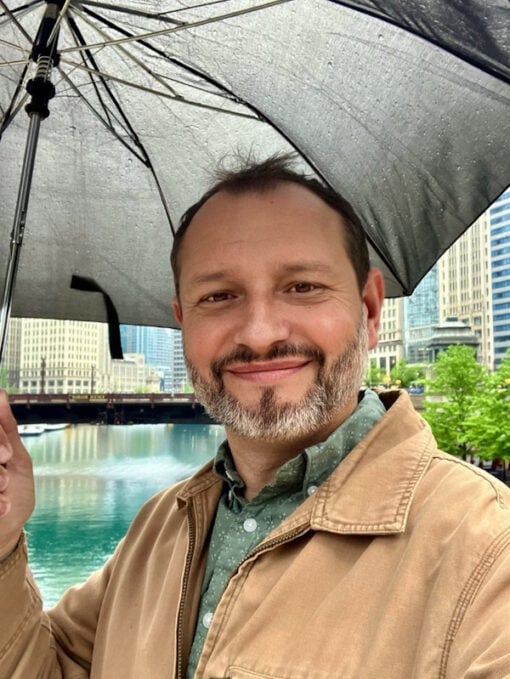
Vladislav (Vlado) Šolc (pronounced “Schultz”) is a professional psychotherapist and Jungian analyst practicing in Milwaukee, Wisconsin. Vlado received training from the C. G. Jung Institute of Chicago and Charles University in Prague. He lives in constant awe of the miracle of existence. He is also the author of six depth-psychology-oriented books: Psyche, Matrix, Reality; The Father Archetype; In the Name of God—Fanaticism from the Perspective of Depth Psychology; Dark Religion: Fundamentalism from the Perspective of Jungian Psychology (with George Didier), Individuation and Democracy in the Times of Conspiracy Theories; Dark Religion: Psychology of Denial and Uncovering of Reality (with George Didier), Dark Religion: Psychology of Denying and Uncovering of Reality (with George Didier).
Links: Vlado Solc’s Website | Vlado Solc’s Lectures Available on the C. G. Jung Institute of Chicago Website
3 Responses
Thank you for your comment, Ann. I’m pleased to hear that this interview was valuable for you. Warmly, Vlado
I just wanted to say how glad I was to find this interview with Vlado, quite by chance, when I landed on the site. I first came across his writing in 2016, when I was looking for information about certain archetypes, and was well rewarded. Ever since, I’ve always been keen, and pleased, to hear his insights. Thanks to all for making this available.