
A New Model of Psychological Types
 with John Beebe, MD
This episode is the first hour of the seminar A New Model of Psychological Types.
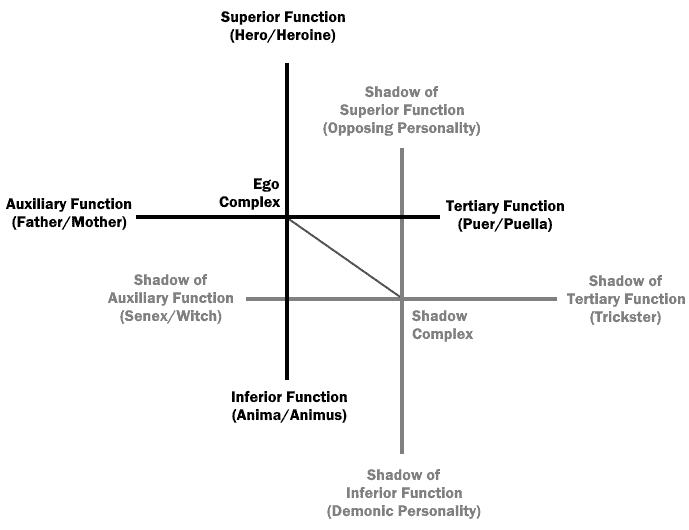
Jung’s theory of psychological types is an attempt to make comprehensible the regular differences between individuals. His concepts of introversion and extraversion, thinking, feeling, sensation, and intuition have gained wide currency since their introduction in 1920. However, applying these concepts to practical situations is often confusing. Dr. Beebe’s new model of typology shows how the eight types relate to complexes that can be recognized in dreams and styles of behavior. The model, which permits the types to be recognized more easily and with more precision, is illustrated with examples drawn from clinical work and works of creative imagination. It was recorded in 1988.
The following diagram outlines Beebe’s framework (click image to enlarge):
 John Beebe, MD a physician specializing in psychotherapy, is a Distinguished Life Fellow of the American Psychiatric Association and a past president of the C. G. Jung Institute of San Francisco. He is the author of Integrity in Depth, editor of C. G. Jung’s Aspects of the Masculine, and co-author of The Presence of the Feminine in Film. He is the founding editor of The San Francisco Jung Institute Library Journal (now titled Jung Journal: Culture and Psyche), and a was the first American co-editor of the London-based Journal of Analytical Psychology. An international lecturer, Beebe is widely known for his work on psychological types, the psychology of moral process, and the Jungian understanding of film. Recently he has been engaged in training the first generation of analytical psychologists in China.
Podcast: Play in new window | Download (36.4MB)
For the complete series, click here.
For all seminars by John Beebe, click here.
© 1988 John Beebe. This podcast is licensed under a Creative Commons Attribution-NonCommercial-NoDerivatives 4.0 International License. You may share it, but please do not change it, sell it, or transcribe it.
Music by Michael Chapman
Edited and produced by Benjamin Law
One Response
After reading the brief description of the new model, I am not sure that it is as flexible as Jung’s model, which as we know, describes first, relative strengths and weaknesses of processing psychological input and output. Associating typology to complexes, counter-sexual aspects and shadow, among other aspects, may well lessen Jung’s flexible model even if it does introduce possible and potentially useful therapeutic pathways. In addition, I do not recognize my own pathway in this model, whereas I map it quite well with Jung’s original model as I progressively and somewhat painfully accessed the fourth function. I ask: Is the new model progress or unavoidable complication in experimentation?