Ecopsychology Voices | Jungian Ecopsychology for the Younger Generation with Dennis Merritt

Ecopsychology Voices is an interview series with some of ecopsychology’s luminaries. Linda Buzzell and Carol Koziol host this series which is sponsored by the Canadian Ecopsychology Network.

https://www.facebook.com/watch/?v=2509058002660237

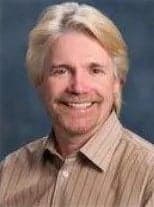
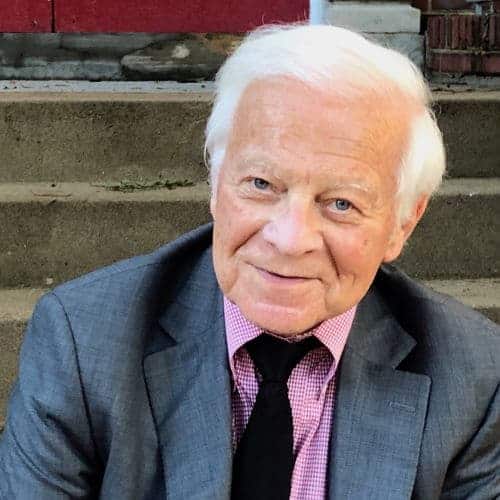
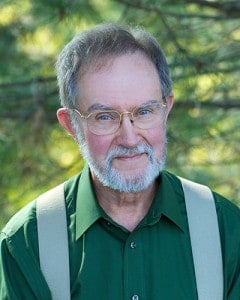
Dennis L. Merritt, PhD, is a Jungian psychoanalyst and ecopsychologist in private practice in Madison and Milwaukee, Wisconsin. Dr. Merritt is a diplomate of the C.G. Jung Institute, Zurich and also holds the following degrees: M.A. Humanistic Psychology-Clinical, Sonoma State University, California, Ph.D. Insect Pathology, University of California-Berkeley, M.S. and B.S. Entomology, University of Wisconsin-Madison. Over twenty-five years of participation in Lakota Sioux ceremonies have strongly influenced his worldview.

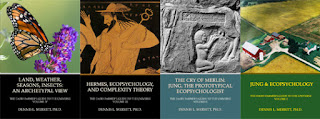
Dr. Merritt is the author of Jung, Hermes, and Ecopsychology: The Dairy Farmer’s Guide to the Universe Volumes 1 – 4.

Links: Dennis Merritt’s Blog | Dennis Merritt’s Practice Website | Dennis Merritt’s Page on the C. G. Jung Institute of Chicago Website | Ecopsychology Voices | Canadian Ecopsychology Network

Murray Stein | Symbols and the Transformation of the Psyche

My personal physician in Thun recently complained about the many patients he sees who are perfectly healthy but come to him doubled up in pain and complaining about their symptoms. “They are crazy,” he said throwing up his hands in frustration. “Perfectly healthy people, but not able to live with their health! On the other side I have patients who feel as healthy as can be, and I have to tell them they have six months to live because of a recently discovered lymphoma. I’d like to send the healthy ones to the moon! They’re nuts!”

His complaint reminded me of the opening pages in Jung’s 1936 Terry Lectures at Yale University entitled “Psychology and Religion.” There he is telling the audience about the power that a neurosis can have over patients’ lives. For instance, he says, a man imagines he has cancer, but there is no physical evidence of cancer in his body. He then feels at a complete loss and becomes convinced that he is crazy. So he consults Jung, a psychiatrist. “Help me, doctor. I think I’m dying from cancer but this is nonsense, yet I can’t stop it!” What does the psychiatrist Jung do with this imaginary cancer? “I told him that it would be better to take his obsession seriously instead of reviling it as pathological nonsense. But to take it seriously would mean acknowledging it as a sort of diagnostic statement of the fact that, in a psyche which really existed, trouble had arisen in the form of a cancerous growth. ‘But,’ he will surely ask, ‘what could that growth be?’ And I shall answer: ‘I do not know,’ as indeed I do not. Although… it is surely a compensatory or complementary unconscious formation, nothing is yet known about its specific nature or about its content. It is a spontaneous manifestation of the unconscious, based on contents which are not to be found in consciousness… I then inform him… that his dreams will provide us with all the necessary information. We will take them as if they issued from an intelligent, purposive, and, as it were, personal source…. The symptom is like the shoot above ground, yet the main plant is an extended rhizome underground. The rhizome represents the content of a neurosis; it is the matrix of complexes, of symptoms, and of dreams. We have every reason to believe that dreams mirror exactly the underground processes of the psyche. And if we get there, we literally get at the ‘roots’ of the disease.”

The delusional idea of a cancerous growth in a healthy body, then, is a symbol, which can provide a point of entry into the unconscious realm of complexes, processes, and hidden conflicts. And just as a physical cancer will suck the life out of a living organism if it is allowed to grow and remains unchecked, a psychic cancer too will drain a person’s life of psychic energy and produce a state of hopeless stagnation and eventually even psychic death. Symbols have the power to do just that. They collect, hold, and channel psychic energy, for good or ill.

In one sense, this psychic symptom is a metaphor, in that it is borrowing the language of physicality (cancer, illness) and applying it to the psychic domain. This transfer of language from one domain to another is what poets do when they employ metaphors. The psyche is involuntarily acting in a poetic fashion by stating, “I am sick with cancer,” when the person, were he more conscious of his psychic suffering, would say, “I am in profound despair,” or “I have no energy,” or “I am in hopeless conflict and it’s eating me alive!” But this patient cannot say that. He can only say: “I am convinced I have cancer, and I can’t get this irrational idea out of my head!” He is an unwilling poet. He has not chosen this symbol consciously or voluntarily; it has chosen him. He is unfree to dismiss it and unable to interpret it. So he goes to the analyst, and he confesses that he is possessed by a symbol and doesn’t know what it means. Understandably, he is humiliated by the stupid symptom and its unyielding grip on him. Jung says that such morbidity is usually shameful, and the patient is embarrassed to admit this weakness. He is in the grip of a complex, and this psychic factor – powerful, autonomous, and unconscious – is symbolized as a cancer. It must be analyzed and made conscious so that the very real suffering caused by the symptom-symbol can be transformed into psychic suffering. Perhaps other psychic resources can thus also be constellated, which will assist in bringing about the free flow of energy (libido) into more life enhancing tasks and goals.

What is a symbol?

As Jung understands and employs the term symbol, it is different from a metaphor in that what it is communicating or presenting to consciousness is utterly untranslatable into any other terms, at least for the time being. Symbols are opaque and often bring thinking to a standstill. Metaphors are transparent and must be so if they are to do their job. They help us think in creative ways “outside the box.” If a poet writes, for instance, that a bridge leaps (“vaulting the sea”) and addresses it as a “harp” and an “altar,” as the American poet Hart Crane does in his famous poem, “To Brooklyn Bridge,” the reader can with diligence puzzle out a sense of what the poet means to communicate. We know what a bridge is, and we know what “vaulting” signifies and what “altars” and “harps” are, and we can think along with the poet and appreciate what he is getting at with these metaphors. The image all refer to sense data in the material world, and reflection will yield interesting ideas about how they belong together and what this unique concatenation signifies. But if a patient says, “I am convinced that that I have a cancerous tumor in my body but there is no evidence, what does this mean?” the psychotherapist must confess, with Jung, “I have no idea what it means, but we can explore the image. By looking at your life, your history, your dreams and fantasies, we may be able to discover something that at this moment is locked out of consciousness and is analogous to a cancer.” It is an important difference. The link between signifier and signified is totally opaque in the case of symbols; with metaphors, on the contrary, this link is evident even if often very complicated and at first glance puzzling.

(more…)

Finding Personal Resilience in Changing Times: An Interview with James Hollis

First, thank you to everyone who participated in our 2020 Holiday Giving Drive. Because of your support, we were able to meet our $25,000 fundraising goal! We could not do this work without you all and appreciate all the support, including those who support the institute in other ways.

In this episode, Patricia Martin interviews James Hollis, PhD, about his recent book Living Between Worlds: Finding Personal Resilience in Changing Times.

James Hollis, PhD was born in Springfield, Illinois, and graduated from Manchester University in 1962 and Drew University in 1967. He taught Humanities 26 years in various colleges and universities before retraining as a Jungian analyst at the Jung Institute of Zurich, Switzerland (1977-82). He is presently a licensed Jungian analyst in private practice in Washington, D.C. He served as Executive Director of the Jung Educational Center in Houston, Texas for many years, was Executive Director of the Jung Society of Washington until 2019, and now serves on the JSW Board of Directors. He is a retired Senior Training Analyst for the Inter-Regional Society of Jungian Analysts, was first Director of Training of the Philadelphia Jung Institute, and is Vice-President Emeritus of the Philemon Foundation. Additionally he is a Professor of Jungian Studies for Saybrook University of San Francisco/Houston. He has written a total of sixteen books, which have been translated into 19 languages. He lives with his wife Jill, an artist and retired therapist, in Washington, DC. Together they have three living children and eight grand-children.

Patricia Martin is a noted cultural analyst, author, and consultant. She has published three books on cultural trends. As a consultant, Patricia has helped some of the world’s most respected organizations interpret social signals that have the power to shape the collective. She’s worked with teams at Discovery Communications, Dannon, Microsoft, Unisys, The Art Institute of Chicago, and the New York Philharmonic. Her work has been featured in the New York TimesHarvard Business ReviewUSA Today, and Advertising Age. She holds an M. A. in literature and cultural studies at the University College, Dublin (honors) and a B.A. in English from Michigan State University. In 2018, she completed the Jungian Studies Program at the C. G. Jung Institute of Chicago, where she is a Professional Affiliate. A scholar in residence at the Chicago Public Library, Patricia has devoted nearly a decade to studying the digital culture and its impact on individuation. She lectures around the world on topics related to the psyche and the digital age, the future of the collective, and the changing nature of individuation, all concepts discussed in her forthcoming book: Will the Future Like You?

Links: James Hollis’s website | James Hollis’s lectures in our online store | James’s Hollis’s online courses through the Jung Society of Washington


This podcast is licensed under a Creative Commons Attribution-NonCommercial-NoDerivatives 4.0 International License. You may share it, but please do not change it, sell it, or transcribe it.
Executive Producer: Ben Law
Producer: Patricia Martin
Music: Michael Chapman


Thank you to our 2020 donors who gave at the Supporting Member level and above: Barbara Annan, Usha and Ashok Bedi, Jackie Cabe Bryan, Eric Cooper and Judith Cooper, Kevin Davis, George J. Didier, James Fidelibus, John Korolewski, Marty Manning, Dyane Sherwood, Deborah P. Stutsman, Debra Tobin, Alexander Wayne and Lynne Copp, Gerald Weiner, Karen West and James Taylor, and Ellen Young. If you would like to support this podcast, click here to join our community of supporters.

Statement from the President | January 4, 2021

All classes and public program events are currently being held online due to COVID-19. Our priority is the health and safety of all our members, and we will continue to monitor the pandemic for the time when it is safe to gather once again. We are hopeful that the vaccines now available will enable us to hold in-person classes and events at the Institute in the Fall, but, given the uncertainty of the COVID-19 situation, for the time being, all learning will continue online. The decision to return to in-person meetings will be based on CDC public health guidance and legal mandates for educational organizations regulating size of gatherings, social distancing, mask-wearing, cleaning and sanitation, and vaccinations.

Please refer back to our website for updates.

Stephanie Buck, President

Change and Renewal: A Conversation with Jean Shinoda Bolen and Jacquelyn Mattfeld

This episode is part of an evening with Jean Shinoda Bolen when the Institute was going through a major change. The Institute was about to sell its building in Evanston and eventually split into two entities, the C. G. Jung Institute of Chicago, which would continue the training of Jungian psychoanalysts, and the C. G. Jung Center in Evanston, which would continue the clinic and related programs. This is the context for a lecture by Jean Shinoda Bolen and this conversation with Jacquelyn Mattfeld. It was recorded on April 3rd, 2003. The lecture portion, “Meeting Hecate at the Crossroad: Making Soul-Shaping Decisions”, which came after this conversation, is available in our store.

This free podcast is made possible by your support. Help us continue to provide educational content worldwide by joining our Holiday Giving Drive. This year has been hard on many institutions, and though we have been able to move much of our work online, not everything is able to be done without being in a room together. Your support will help us make it through this difficult period.

Jean Shinoda Bolen, MD, is a psychiatrist, Jungian analyst, and an internationally known author and speaker. She is the author of The Tao of Psychology, Goddesses in Everywoman, Gods in Everyman, Ring of Power, Crossing to Avalon, Close to the Bone, The Millionth Circle, Goddesses in Older Women, Crones Don’t Whine, Urgent Message from Mother, and Like a Tree with over eighty foreign translations. She is a Distinguished Life Fellow of the American Psychiatric Association and a former clinical professor of psychiatry at the University of California at San Francisco, a past board member of the Ms. Foundation for Women and the International Transpersonal Association. She was a recipient of the Institute for Health and Healing’s “Pioneers in Art, Science, and the Soul of Healing Award”, and is a Diplomate of the American Board of Psychiatry and Neurology. She was in two acclaimed documentaries, the Academy-Award winning anti-nuclear proliferation film Women—For America, For the World, and the Canadian Film Board’s Goddess Remembered. The Millionth Circle Initiative (millionthcircle.org) was inspired by her book and led to her involvement at the UN. She is the initiator and the leading advocate for a UN 5th World Conference on Women (5wcw.org), which was supported by the Secretary General and the President of the General Assembly on March 8, 2012.

Jacqueline A. Mattfeld, PhD has advanced degrees in humanistic gerontology, art history and music history. She has been a member of the faculties of Harvard University, M.I.T., Sarah Lawrence College, Brown University and Columbia University. She is Professor Emerita of Arizona State University and past President of Barnard College in New York City. For nearly twenty years she has taught, lectured and written about the theories and experiences of late life development. She was the co-developer of the MA in Gerontology program at Northeastern Illinois University and established the Program in Creative Aging at the Jung Institute of Chicago. From 2000 through 2006 she was the Executive Director and Director of Public Programs of The C. G. Jung Center in Evanston where she served on the Board of Trustees through 2014.  She now serves as a Board Member Emeritus.

For the lecture portion, CLICK HERE

Links: Make a donation | Jean Shinoda Bolen’s Website | Jean Shinoda Bolen’s Lectures in Our Online Store

This podcast is licensed under a Creative Commons Attribution-NonCommercial-NoDerivatives 4.0 International License. You may share it, but please do not change it, sell it, or transcribe it.
Executive Producer: Ben Law
Producer: Patricia Martin
Music: Michael Chapman


Thank you to our 2019 Supporter level donors: Bill Alexy, Usha and Ashok Bedi, Circle Center Yoga, Arlo and Rena Compaan, Eric Cooper and Judith Cooper, Lorna Crowl, D. Scott Dayton, George J. Didier, Ramaa Krishnan/Full Bloomed Lotus, Suzanne G. Rosenthal, Deborah Stutsman, Debra Tobin, Alexander Wayne and Lynne Copp, Gerald Weiner. If you would like to support this podcast, click here to donate.

Statement from the President | November 30, 2020

As this year comes to a close and we ask for your financial contribution to our annual Holiday Giving drive, there is much to be grateful for. Despite the devastating impact Covid-19 has had with so many lives lost, and futures destroyed, our Institute community has stayed strong, committed to ensuring that we fulfil our educational mission, the advancement of Analytical Psychology. 

When the dangers of Covid-19 became clear to us, the Institute quickly shifted from in-person education to virtual learning. The dedication and professionalism of everyone involved in our Institute community made this necessary pivot successful. This shift has enabled us to continue our educational mission without pause while providing a greater reach, with people from across the country and the world accessing our educational offerings virtually. The Analyst Training Program and the Public Programs’ lecture series remain uninterrupted, and, new in January 2021, begins a six-month program designed specifically for online learning. Other innovations made to meet the individuation needs of people in this time of pandemic include:

  • Jungianthology Blog: interviews with Jungians around the world, essays by members of the Chicago Society of Jungian Analysts, links to free CE courses, and other interesting initiatives by other groups
  • Jungianthology Podcast: free full-length seminars relevant to the current moment
  • Online Store: 40% price reduction on the purchase of recordings during Chicago’s “shelter in place” order
  • Public Program Series: 40% price reduction

Now more than at any other period in recent history, the education provided by the Institute in the depth psychology originating with C. G. Jung is greatly needed. We live in dark times. The personal transformation fostered through our programs and the social renewal made possible when individual learners do their psychic work within a community is the compensatory light to the deepening darkness of repressed Shadow unleashed we see evident today in our country and worldwide. As Jung reminds us, One does not become enlightened by imagining figures of light but by making the darkness conscious.”  The Institute serves the human need for ongoing psychological growth and relational development. Our shared future as a nation, a world community, and perhaps as a planet hinges on this necessary psychic work.

Your financial gift in combination with others’ helps support the C. G. Jung Institute of Chicago broaden its educational programming and strengthen community. Your financial support ensures that the Institute will continue as Chicago’s educational leader, providing multi-faceted educational programs in Analytical Psychology. Your financial gift will have lasting value by contributing to the ongoing success of the Institute. Help support, secure, and strengthen our Institute for today, tomorrow and the future. Be a Holiday Gift Giver 2020.

Be well, be safe this winter season and, many thanks,

Stephanie Buck, President

The Power of Language and its Effect Upon Gender Representation

with Joyce Bogusky, PhD

Today we launch our annual Holiday Giving Drive with this full seminar. We are doing our best to adjust to the realities of the COVID-19 pandemic, but the financial strain is real and we need your help to make it through this difficult time. You can help support this podcast and the existence of the C. G. Jung Institute of Chicago by making a donation.

You can also support us by making a purchase in our online store. Our annual Cyber Sale runs November 25-30. Receive 40% off all audio and video downloads by entering the code CYBER on the CART page before proceeding to checkout.

Jungian analyst Joyce Bogusky considers the work of contemporary women in the fields of linguistics, philosophy, anthropology, psychoanalysis, and feminine psychology, to explore the critical issues and controversies concerning language and its impact on gender representation. Special attention is given to current feminist critiques of language, mechanisms of oppression and self censorship, women’s access to language, and ideological and cultural determinants of expression.

It was recorded on October 29, 1993.

Joyce Bogusky, PhD is a Jungian analyst who has been in private practice in Evanston and Chicago, a professor in the counseling psychology department at Northwestern University, a personal trainer, and a yoga teacher.

Links: Make a Donation

© 1993 Joyce Bogusky. This podcast is licensed under a Creative Commons Attribution-NonCommercial-NoDerivatives 4.0 International License. You may share it, but please do not change it, sell it, or transcribe it.
Executive Producer: Ben Law
Producer: Patricia Martin
Music: Michael Chapman


Thank you to our 2019 Supporter level donors: Bill Alexy, Usha and Ashok Bedi, Circle Center Yoga, Arlo and Rena Compaan, Eric Cooper and Judith Cooper, Lorna Crowl, D. Scott Dayton, George J. Didier, Ramaa Krishnan/Full Bloomed Lotus, Suzanne G. Rosenthal, Deborah Stutsman, Debra Tobin, Alexander Wayne and Lynne Copp, Gerald Weiner. If you would like to support this podcast, click here to donate.

Joseph Cambray | Altered States, Intelligences, and Oracles: Re-visioning the Unconscious

Thank you to the Pacifica Graduate Institute for sharing this video. From the video description:

Recent research into artificial and biological intelligences have clarified differences between consciousness and adaptive intelligences. The contemporary study of altered states compliments this, at times offering ways to engage these intelligences. In this presentation we will explore how the oracle traditions of the ancient world used altered states for noetic purposes and how we might reconsider these traditions in terms of models of the unconscious.

Joseph is CEO-President at Pacifica. He is also past President of the International Association for Analytical Psychology; he has served as the U.S. Editor for the Journal of Analytical Psychology and is on the Editorial Boards of the Journal of Analytical Psychology, The Jung Journal: Culture and Psyche, and Israel Annual of Psychoanalytic Theory, Research and Practice. He has been a faculty member at Harvard Medical School in the Department of Psychiatry at Massachusetts General Hospital, Center for Psychoanalytic Studies; adjunct faculty at Pacifica Graduate Institute. Dr. Cambray is a Jungian analyst in Boston and Providence, RI. His numerous publications include the book based on his Fay Lectures: Synchronicity: Nature and Psyche in an Interconnected Universe and a volume edited with Linda Carter, Analytical Psychology: Contemporary Perspectives in Jungian Psychology. Some of his recent papers include: “Cosmos and Culture in the Play of Synchronicity,” Spring Journal, Jungian Odyssey Series, 4, 133-147, 2012; “Jung, science, and his legacy,” in International Journal of Jungian Studies, 3:2, 110-124, 2011; and “Moments of complexity and enigmatic action: a Jungian view of the therapeutic field,” in Journal of Analytical Psychology, 56 (2) 296-309, 2011. 

Links: The Pacifica Graduate Institute YouTube Channel | The Pacifica Graduate Institute

Stepping Onto the Path: Interview with Director of Training Boris Matthews

I want to personally introduce our new producer, Patricia Martin. She is a cultural analyst, author, consultant, Professional Affiliate (graduate of our Jungian Studies Program), and member of our Program Committee. This is the first interview she’s doing for us and we are developing plans to do more. I’m grateful that she’s willing to give her own time to help us bring interesting discussions to this podcast. -Ben Law

In this episode, Patricia Martin interviews Boris Matthews, current Director of the Analyst Training Program at the C. G. Jung Institute of Chicago, about his own life journey, his perspective on analysis, education, and individuation, and the program itself.

Note: There was some mysterious background hum that we did our best to remove, but the audio quality is affected somewhat. We will continue to work on improving the audio quality for these interviews.

Boris Matthews, PhD, LCSW, NCPsyA graduated from the C.G. Jung Institute of Chicago, is a member of the Chicago Society of Jungian Analysts, and maintains a practice of analytical psychology in the Milwaukee and Madison, WI, areas. He is particularly interested in working with persons who recognize need to develop a balanced adaptation to the “outside” and to the “inside” worlds, work that involves awareness of the individual’s psychological typology. Dreams, active imagination, and spiritual concerns are integral elements in the analytic work, the ultimate goal of which is to develop a functioning dialog with the non-ego center, the Self. He serves as the Director of Training of the Analyst Training Program, regularly teaches classes for analytic candidates, and conducts study groups.

Patricia Martin is a noted cultural analyst, author, and consultant. She has published three books on cultural trends. As a consultant, Patricia has helped some of the world’s most respected organizations interpret social signals that have the power to shape the collective. She’s worked with teams at Discovery Communications, Dannon, Microsoft, Unisys, The Art Institute of Chicago, and the New York Philharmonic. Her work has been featured in the New York TimesHarvard Business ReviewUSA Today, and Advertising Age. She holds an M. A. in literature and cultural studies at the University College, Dublin (honors) and a B.A. in English from Michigan State University. In 2018, she completed the Jungian Studies Program at the C. G. Jung Institute of Chicago, where she is a Professional Affiliate. A scholar in residence at the Chicago Public Library, Patricia has devoted nearly a decade to studying the digital culture and its impact on individuation. She lectures around the world on topics related to the psyche and the digital age, the future of the collective, and the changing nature of individuation, all concepts discussed in her forthcoming book: Will the Future Like You?

Links: The Analyst Training Program | Lectures by Boris Matthews in our Online Store | Boris Matthews on the Jungianthology Podcast & Blog


This podcast is licensed under a Creative Commons Attribution-NonCommercial-NoDerivatives 4.0 International License. You may share it, but please do not change it, sell it, or transcribe it.
Music by Michael Chapman
Edited and produced by Benjamin Law


Thank you to our 2019 Supporter level donors: Bill Alexy, Usha and Ashok Bedi, Circle Center Yoga, Arlo and Rena Compaan, Eric Cooper and Judith Cooper, Lorna Crowl, D. Scott Dayton, George J. Didier, Ramaa Krishnan/Full Bloomed Lotus, Suzanne G. Rosenthal, Deborah Stutsman, Debra Tobin, Alexander Wayne and Lynne Copp, Gerald Weiner. If you would like to support this podcast, click here to donate.

Memories, Dreams Reflections: Exploring the Depths, a 6-Month Online Program

Arlo Compaan, co-chair of the Institute’s Program Committee and past Director of Training, interviews the facilitators of our new six-month online program Memories, Dreams, Reflections: Exploring the Depths. In this monthly online weekend program, Jungian analysts and experts will introduce the major themes of Analytical Psychology as Carl Jung developed them across his life, beginning in his early 20s and ending in his 80s. Through presentations, facilitated large and small group interaction, and paired experiential exercises, we will explore these themes from Jung’s writings in relationship to the events of his life and then connected to our contemporary experiences.

By following Jung into the depths of his experience, we will deepen our understanding of these themes in our lives:

  • Adaptation to our inner world and to the outer world
  • The relationship between spirit and matter
  • The individual and collective unconscious
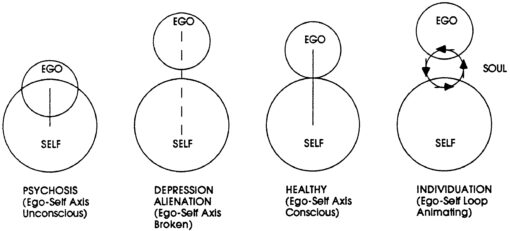
  • The relationship of consciousness (ego) to the Self
  • Daily life and dream life, images, and symbols

The program will run from January through June, 2021. This interview was recorded in October 2020.

Adina Davidson, PhD is a Jungian analyst practicing in Cleveland, Ohio. She trained at the C G Jung Institute of Chicago and graduated in September 2019. She is particularly interested in the ways we personally and collectively make meaning of our lives through telling our stories.

Andrea Gaspar Gonzalez, PsyD is a clinical psychologist practicing in the Chicagoland area, with a focus on the treatment of trauma and sexual abuse. She is a recent Fellow of the Jungian Psychotherapy Program (2018–2020) and graduate of the Jungian Studies Program (2014–2016) at the C G Jung Institute of Chicago. Her current research is focused on collective psyche, application of Jung’s theories to the present cultural climate, and re-examining archetype and archetypal material, especially as it relates to the concept of the feminine, from a fourth-wave feminist standpoint.

Daniel Ross, RN, PMHNP has been a nurse for 40 years and in hospice for over 30. As a Psychiatric Mental Health Nurse Practitioner, he brings both a medical and psychiatric experience to the field of end-of-life care. He is a Jungian Analyst at the C G Jung Institute of Chicago. Dan works in the field of Hospice and Palliative Care and is in private practice as a psychotherapist in Chicago.

Click here to learn more about the program and to register


This podcast is licensed under a Creative Commons Attribution-NonCommercial-NoDerivatives 4.0 International License. You may share it, but please do not change it, sell it, or transcribe it.
Music by Michael Chapman
Edited and produced by Benjamin Law


Thank you to our 2019 Supporter level donors: Bill Alexy, Usha and Ashok Bedi, Circle Center Yoga, Arlo and Rena Compaan, Eric Cooper and Judith Cooper, Lorna Crowl, D. Scott Dayton, George J. Didier, Ramaa Krishnan/Full Bloomed Lotus, Suzanne G. Rosenthal, Deborah Stutsman, Debra Tobin, Alexander Wayne and Lynne Copp, Gerald Weiner. If you would like to support this podcast, click here to donate.

Dennis Merritt | Use of the I Ching in the Analytic Setting

The First International Conference on Jungian Psychology and Chinese Culture was held in Guangzhou, China in December, 1998. My paper was among the conference papers translated into Chinese and later published in English in Quadrant XXXI (2) Summer 2001. An abridged and slightly revised version is presented here.

Hexagram 42, Increase

For many Westerners an introduction to Chinese culture comes through the use of the I Ching. This profound book, a compendium of wisdom extending back to the roots of one of the planet’s most ancient cultures, has become an important companion for many in the West, including myself. Use of the I Ching challenges the reigning scientific paradigms in Western culture and brings a dimension to the Jungian psychoanalytic process that is sympathetic to the deepest and truest spirit of Jungian psychology.

            In Jungian terms, one could say the I Ching is a book that emerged out of the archetypal depths of the human psyche and the psychoid dimensions of the Self. The origins of dreams and the genesis of hexagrams in response to questions addressed to the I Ching are grounded in the same source. The Chinese ideogram for the sage, “the ear listening to the Inner King,” describes the process and goal of Jungian psychology.

            Scientists are giving ecological perspectives more credibility, where patterns of relationships are central. Psychoneuroimmunology research and the statistical verifications of the power of prayer and belief blur the distinctions between mind and matter. Our outlook on life, the way we perceive the world, and our ability to reflect and see meaning in experiences have been shown to affect our health and physical well-being. Dreams, particular psychological approaches, certain spiritual practices, and the I Ching address these issues at deep and subtle psychogenic levels where mind and matter meet (1).

            Analysts are in a good position to notice synchronistic events because we work with dreams at an archetypal level. Synchronistic events are usually related to archetypal events like birth, death, strong love relationships, and jealousy. Circumstantial evidence that synchronicities occur prompted me to develop an experiment to statistically test the possibility. This was part of my thesis (1983) at the Jung Institute in Zurich entitled “Synchronicity Experiments with the I Ching and Their Relevance to the Theory of Evolution.”

            Synchronicity convinced Jung there was an element of the psyche outside time and space: space and time are relative to the psyche (3). Incorporating the concept of synchronicity into his theoretical system late in his life led Jung to substantially reformulate his concepts of archetypes and the collective unconscious, putting them on a transcendent basis. Jung thought of archetypes as forms of existence without time and space, with the archetype per se being a “just so” ordering principle, an imperceptible structural element giving order to ideas and completely integrated with physical reality (4). Archetypes have a psychoid nature, meaning they have both a psychic and a physical dimension: psychic and physical are two sides of the same coin (5). An analogy in physics would be light, which behaves as a particle and a wave; matter (particles) and field somehow being two sides of the same phenomena…

(more…)

Dan Ross on Death and Immortality

In this video seminar, Daniel Ross shares some of his work from our podcast episode “Death Panels: Our Cultural Complex Around Death”. This event was hosted by the USA India Jung Foundation – a 501c(3) foundation that does charitable work in India and USA – and was presented at the Ahmedabad Jung Center, India an IAAP Developing group (uijf.org) and moderated by Ashok Bedi – the IAAP liaison person for the Ahmedabad Jung Center. Thank you to the USA India Jung Foundation for sharing this recording of a seminar we only have on audio.

Daniel Ross, RN, PMHNP, MSN, MBA has been a nurse for 40 years. He has worked extensively as Director of Clinical Services in the field of home health care and hospice. As a Psychiatric Mental Health Nurse Practitioner, he brings both a medical and psychiatric experience to his work. He currently works part time in the field of Palliative Care and Hospice as a Nurse Practitioner, visiting patients in their home or nursing facility helping them in their transition to hospice. He is also a Jungian Analyst in private practice in downtown Chicago.

Links: Dan Ross’s Page on the C. G. Jung Institute of Chicago Website | Dan Ross’s Website | The USA India Jung Foundation Website

Filter Posts

  • About Jung Chicago Radio & Blog

    Jung Chicago Radio is home to a variety of podcasts that range from archival seminar recordings (Institute Archives), to interviews (Jung in the World) to discussion on film (Healing Cinema), fairy tales (Jungian Ever After), and our programs.

    Our Blog shares essays, articles, video, audio, and other resources by members of the Chicago Society of Jungian Analysts and other groups that support the education and development of our community.

    The views and opinions expressed in the podcasts and blog posts are those of the respected speakers or authors and do not necessarily represent the views of the C. G. Jung Institute of Chicago.

    Login

    This search engine will search our public programs, the Jung Chicago Radio and Blog, and our store.

    To search only the store, visit our Store page.

    If you’re looking for a Jungian Analyst, use our Find an Analyst search engine or browse the Chicago Society of Jungian Analysts page.